


technology
Fidget Book lets you pull a fashion photograph apart
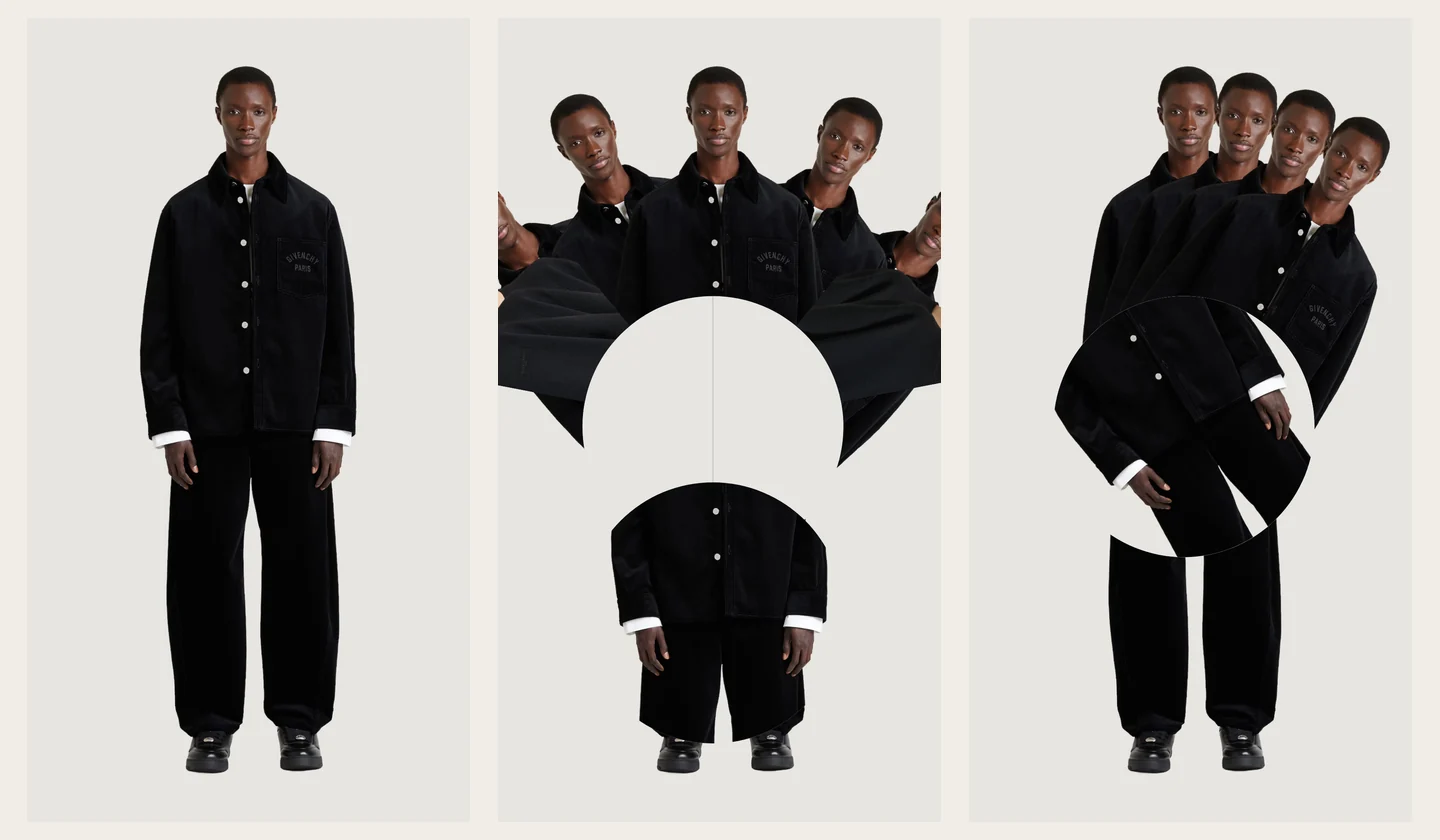
There’s a disc at the waist of a model in Fidget Book. Pull it down and five copies of his upper body fan out above his trousers. A short pull lets you fold him back together. Pull far enough, let go, and the next outfit winds into place. You’ve just turned a page in a lookbook without touching an arrow. Play the three Fidget Book studies .
Frank Nitty 3000 and I started a joint venture to make work like this for companies. Frank makes collages and films. I build things you can operate in a browser. The part we both care about is deciding what someone should be able to do with a picture. See Frank’s work .
The beer invitation
I used to send Frank a GIF when I wanted to get a beer. One time I took a reel he’d made, pulled out 47 frames and used them to build a website. He’d hung a sneaker over a man’s head. In my version I gave the man a banana. Frank deserves the credit for the composition. I’ll take responsibility for the banana. How I turned Frank’s reel into an invitation .
When that worked, we kept going. Could an art director give the visitor a part in the picture and still have the product come across? The brief for Fidget Book had a useful constraint. Start with the catalogue photographs a company already owns. Someone’s already cast the model, lit the clothes and picked the shot. That work should still be visible when you lift your thumb.
What happens when you let go
Take the disc again. Pull it down and a little to one side. When you release it on a short pull, two things happen together. The disc swings sideways like a weight on a string, and the string shortens as the outfit comes back together. A grandfather clock has the luxury of keeping its pendulum the same length. Ours has to work while you’re changing it.
The browser keeps track of angular momentum, labelled p here. The same momentum turns the disc faster on a shorter string. Damping takes some of the swing out at each step. We also cap it. Put enough energy into an uncapped pendulum and you’ve invented a very bad way to look at a jacket.
This is the return on a short pull with normal motion enabled. The cubic term makes a deep stretch pull back harder. The squared term only kicks in near the end of the travel. There’s a separate decision about when you’ve pulled far enough to turn the page. That’s where the art direction comes back in. An energetic wobble should never accidentally change your outfit.
The gold ball knows which hand is underneath it
In the third study a hand balances a gold ball, a mirror and a beauty product, in that order. Drag the stack sideways and watch the ball. On the WebGL version, part of what you see in the metal comes from the hand currently beneath it. The browser takes the same hand artwork you’re looking at and bends a reflection around the ball.
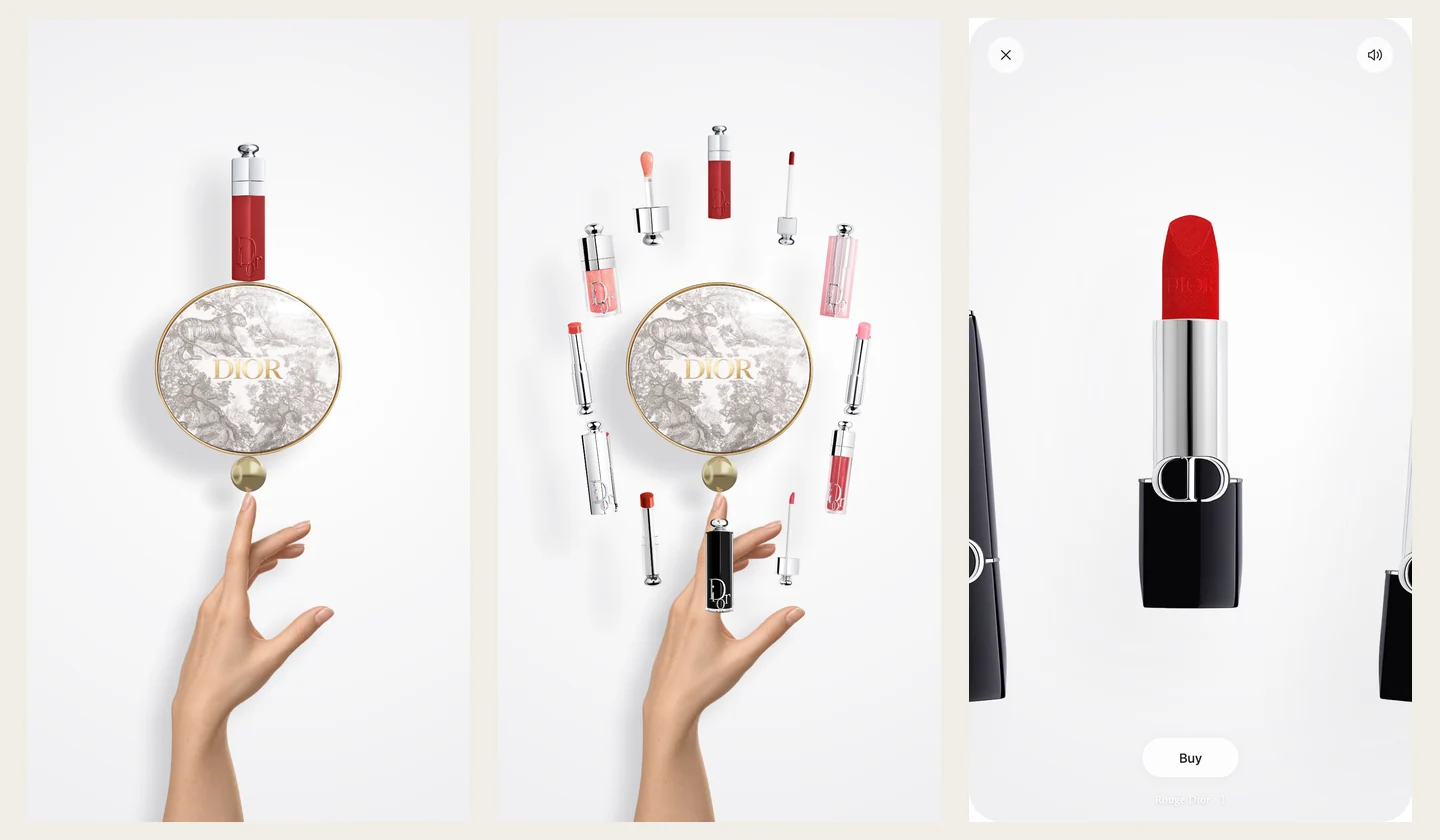
That first fraction answers a very practical question. For this point near the rim of the ball, where should we look in the artwork to find the reflected colour? The second line lets the highlight lose its yellow tint towards the edge. Tap the mirror and the products open into a wheel. Pick a lipstick and it comes forward for a closer look. Nobody needs to know what a shader is to find their shade.
We also built a Shopify version where three hands pass sweets between them. The merchant chooses the collection and supplies the artwork inside Shopify. These are independent studies. You can follow a sweet all the way to its ordinary product page in the Shopify storefront case . If you want to try a different gesture on the same phone, there’s a shelf of browser experiments .
I’d love to hear from the company with a beautiful shoot and a website they’re bored of. A ring that begs to be spun, a coat with a lining worth finding, a bottle that looks completely different on its side. Those are three different briefs. The part of this new era of imagination I like is that the person looking at the picture gets a hand in what happens next. Send Frank and me the campaign photograph you’d start with .
Interested in this?
Learn about Technology →