technology
We asked for 94 keywords. We wrote five pages.
We researched 94 phrases for Lyfar Studio, kept the original responses, and added five buying guides. The useful part was deciding what each visitor wanted to do. Sorting the spreadsheet by its largest number would have given us a different site.
DataForSEO returned a monthly search estimate for 47 phrases. The other 47 came back null. Half a spreadsheet saying “I don’t know” is a decent start to a research project. Less useful for a triumphant presentation, but we survived.
This is the work behind the Hong Kong service guides : the data we bought, the pages we chose, and the claims we can make after publishing them.
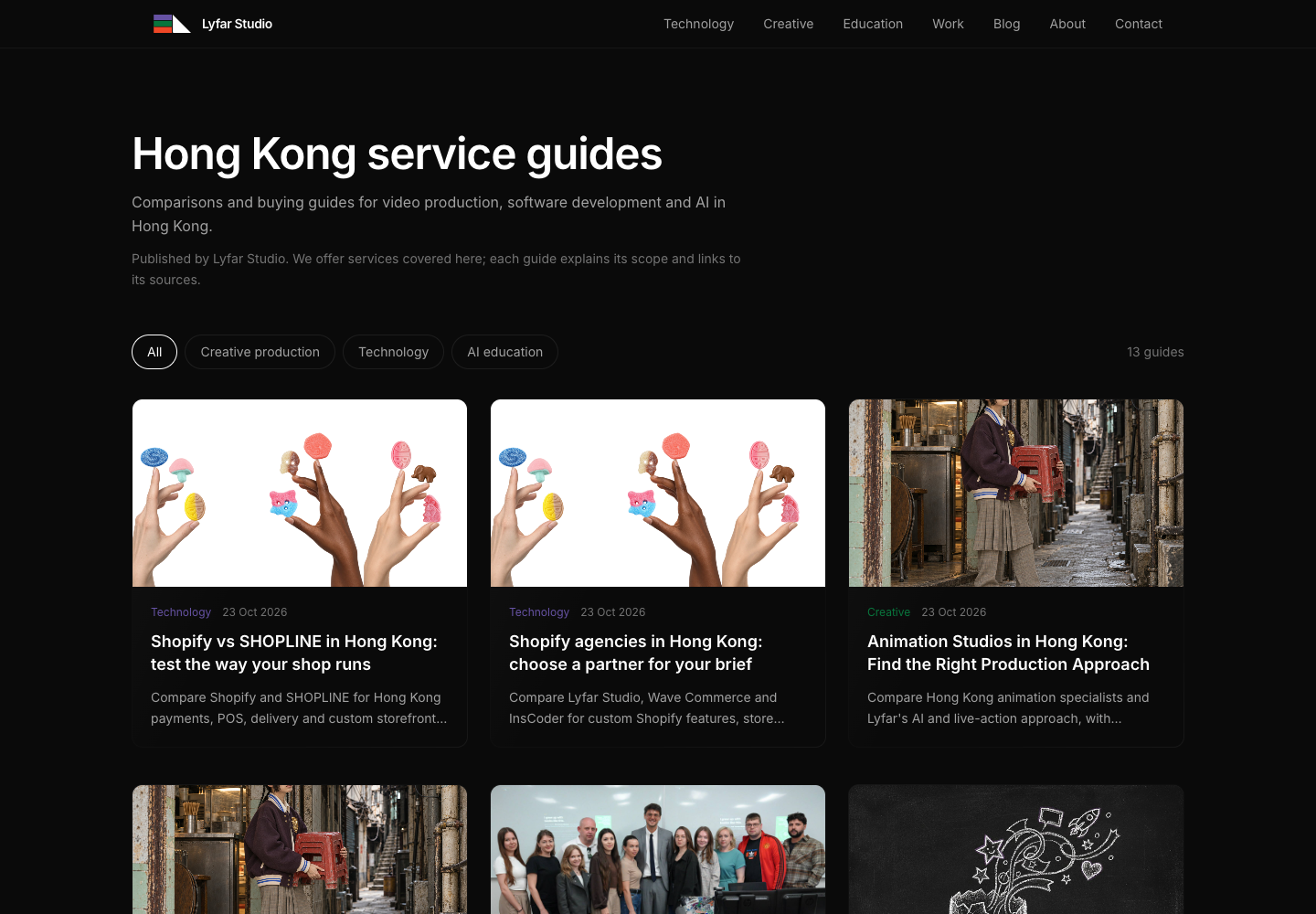
The real guide hub, captured on 23 October 2026. We added five guides to the eight already published. The card artwork belongs to the linked projects; the Kowloon images come from our generated film study.
Start with the work you can show
Lyfar Studio covers technology, creative production and AI education. That’s enough territory to produce a very boring website if we start generating articles for anything containing “Hong Kong”.
We already had eight guides. They covered decisions such as choosing a web developer, briefing a corporate film and finding an AI workshop. Before adding pages, we mapped those existing answers against the work we could demonstrate.
Two recent projects gave us something concrete: an interactive Shopify storefront prototype and our Kowloon fashion film study . The storefront showed a custom interaction inside a Shopify theme. The film showed a directed sequence, with image generation and editing decisions behind it.
Those are useful examples. They don’t turn a development store into a merchant launch, or an independent fashion study into a brand commission. I have enough work without inventing additional clients for myself.
From there, we could ask sensible questions: does someone need help choosing a Shopify agency, choosing a commerce platform, or choosing a video tool? Those require different answers.
Buy a small batch. Keep the receipt.
On 23 October 2026 we ran one Google Ads volume request containing 94 unique phrases, three keyword-idea requests and ten Google search-result requests through DataForSEO . All fourteen task responses succeeded. Their returned costs totalled US$0.38. That’s the API charge for this batch, not the cost of doing the research.
We set the market to Hong Kong and the language to English. The volume response excluded search partners. Its latest monthly history entry was September 2026. We haven’t measured Cantonese-language demand with this batch, and those numbers aren’t worldwide totals.
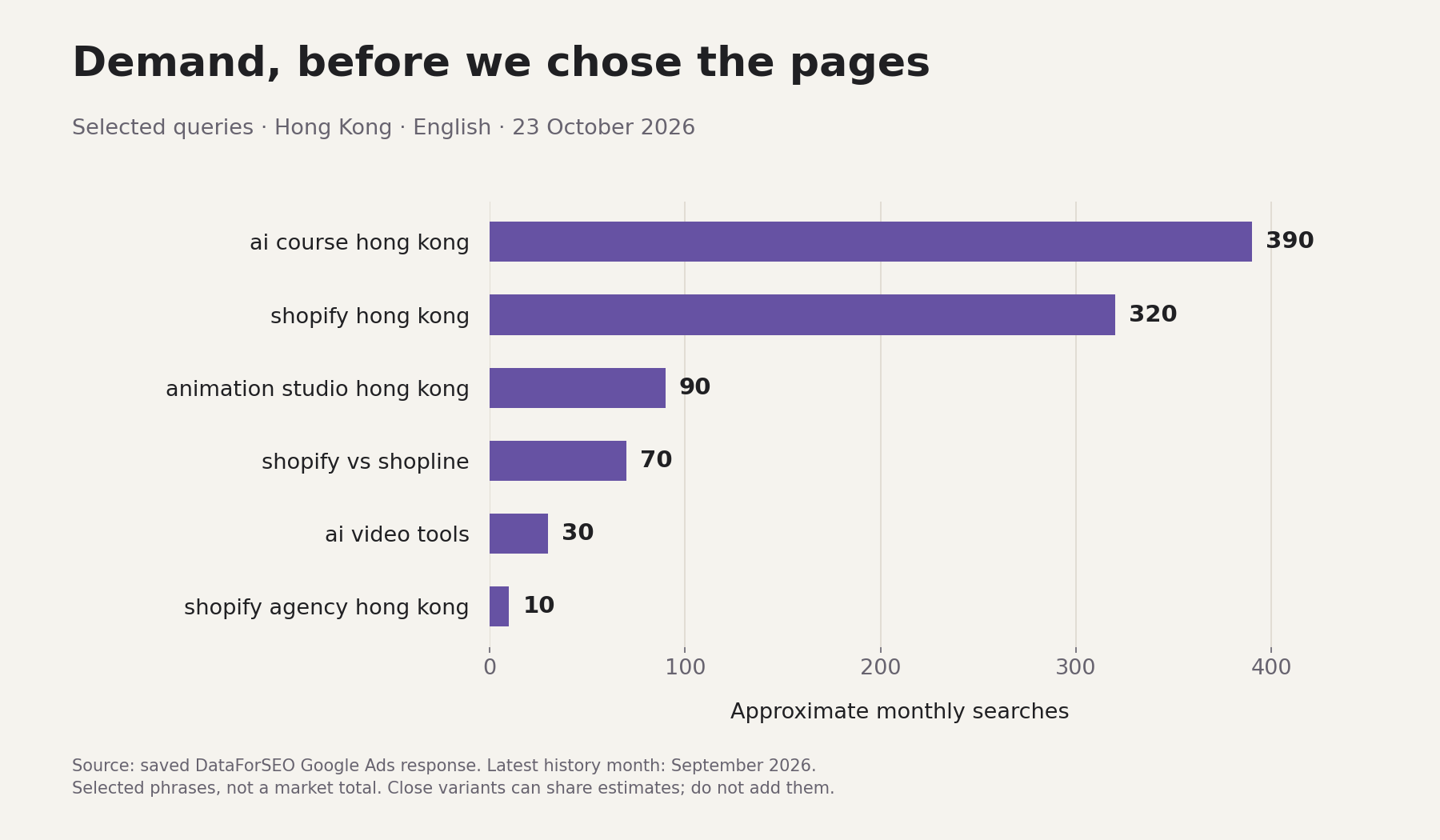
Rendered from the saved response. These are approximate monthly averages from Google Ads, not visits to lyfar.com or forecasts of future enquiries.
The runner saves the request before calling the API, then saves the full response and records the returned cost. It reuses cached responses on a later run and checks a campaign spending cap before new calls. A chart should be something we can rebuild from a file, not a number copied into a slide and gradually promoted to fact.
Our extraction keeps missing values visible. This small example reads the archived response without making another paid request:
import json
from pathlib import Path

response = json.loads(Path("volume.json").read_text())
rows = response["tasks"][0]["result"]

for row in rows:
    volume = row["search_volume"]
    label = "unreported" if volume is None else str(volume)
    print(row["keyword"], label, sep="\t")
The temptation is to replace blanks with zero and move on. That would change the meaning of 47 rows. DataForSEO defines null as no reported data . The same documentation says its competition field concerns paid search, so a LOW label doesn’t tell you that an organic ranking will be easy. Similar phrases can also receive combined estimates. We don’t add “AI course” and “AI courses” together and announce a larger market.
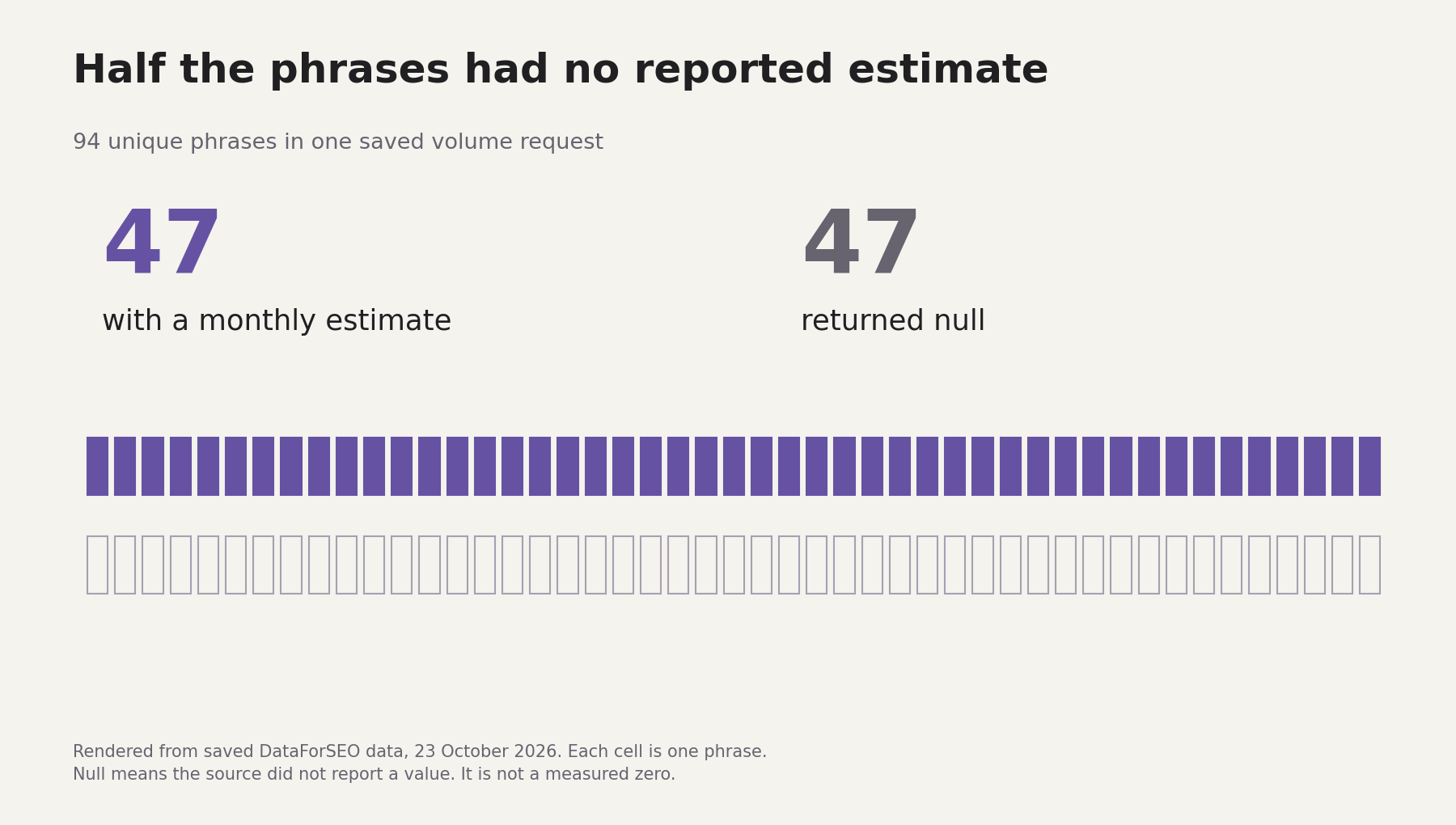
Every cell represents one phrase in the request. Empty cells show unreported values, not zero demand.
Read what people actually get back
“Shopify Hong Kong” returned an estimate of 320 monthly searches. “Shopify agency Hong Kong” returned 10.
I like a large number as much as the next person staring at a spreadsheet. But the saved results for the broad phrase began with Shopify’s own site, its payments documentation, an explainer, its contact page and its pricing page. Someone looking for a payment setting doesn’t need a studio introduction.
The agency query brought back agency pages and supplier lists. We chose to write a guide to selecting a Shopify partner around that decision. Separately, “Shopify vs SHOPLINE” had an estimate of 70 and supported a platform comparison . Hiring someone and selecting the software are two different jobs, even when both involve a shopping bag icon.
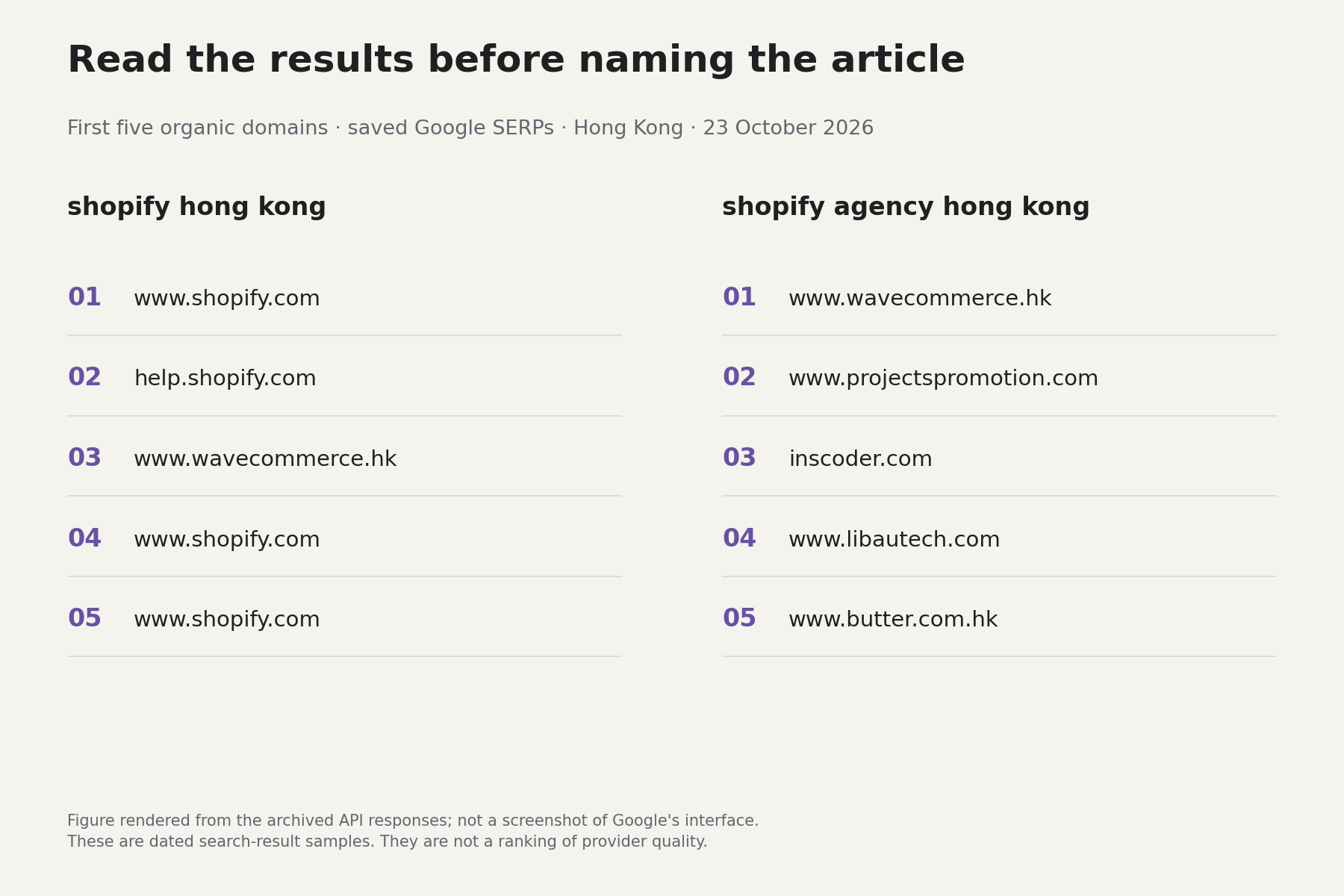
A rendering of our archived search-result data, not a screenshot of Google’s interface. These samples record one date and market; they don’t rank the quality of the companies.
The largest phrase in the volume request, “AI video generator”, came back at 3,600. Its search results and related queries leaned towards generator products and free tools. We used it as context, then wrote a guide to choosing video tools for brand work , where our production experience could help. The distinction depends on reading the results. A volume column cannot make it for you.
Give each page a job
Our new guides covered five decisions: a Shopify partner, a commerce platform, an AI course, an animation supplier and video-generation tools for a brand brief.
We kept “best AI course Hong Kong” and the broader course phrase on the same course guide . One useful comparison can handle both. The existing corporate-training guide still serves a different reader: someone arranging learning for a team.

The individual course guide links to the separate corporate-training decision. The classroom image is from our HKU teaching work.
We deferred an app-development-cost article despite its reported estimate of 10. A credible cost guide needs scope and pricing evidence. I could write “it depends” six times and put a very wide range in a table, but you can get that experience for free from a builder standing in your kitchen.
This was the editorial loop:
flowchart TB
  A[Work we can demonstrate] --> B[Saved keyword and search data]
  B --> C[Reader's decision]
  C --> D{Already answered?}
  D -->|Yes| E[Improve the existing page]
  D -->|No| F[Write a distinct guide]
  E --> G[Check sources and links]
  F --> G
The same question belongs near the start of a client build. For EVia’s multilingual site , the page structure has to make sense to a person choosing a charging solution. Research only earns its place when someone changes a page, a brief or a decision because of it.
Publishing is another piece of work
We put these articles in /guides/, with topic filters, source links and review dates. The hub says that Lyfar offers services covered in the guides. Readers deserve to know who’s making the comparison.
We linked the Shopify guides to each other and to the storefront prototype. The video-tool guide points to the film study. Those links let you move between the buying advice and the work behind it. They’re also a reason to revisit older posts when we publish something related.
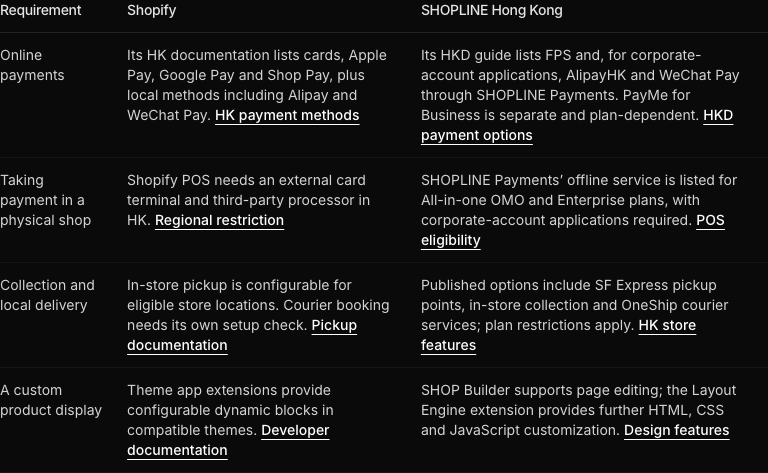
The published comparison table. We checked the desktop layout and the horizontal table scroll on mobile during the release.
The release checks covered public responses, canonical URLs, images, internal links, the guide hub and sitemap. They also checked that we hadn’t changed the existing homepage and service copy while adding the new material. I want to publish an article without accidentally adopting a new personality on the front page.
Those checks establish that readers can reach the pages. We don’t yet have a ranking or enquiry result to report from this release. Google’s own guidance for AI search features points to the usual search eligibility and content fundamentals; it doesn’t promise inclusion. We’ll need search and referral evidence before writing that sequel.
For your own site, pick one service you can prove you deliver. Find the decision someone has to make before hiring you, inspect the search results, and check whether you’ve already answered it. Then write the page that helps them make it.
Interested in this?
Learn about Technology →