Touch Grass: Sound Healing iOS App
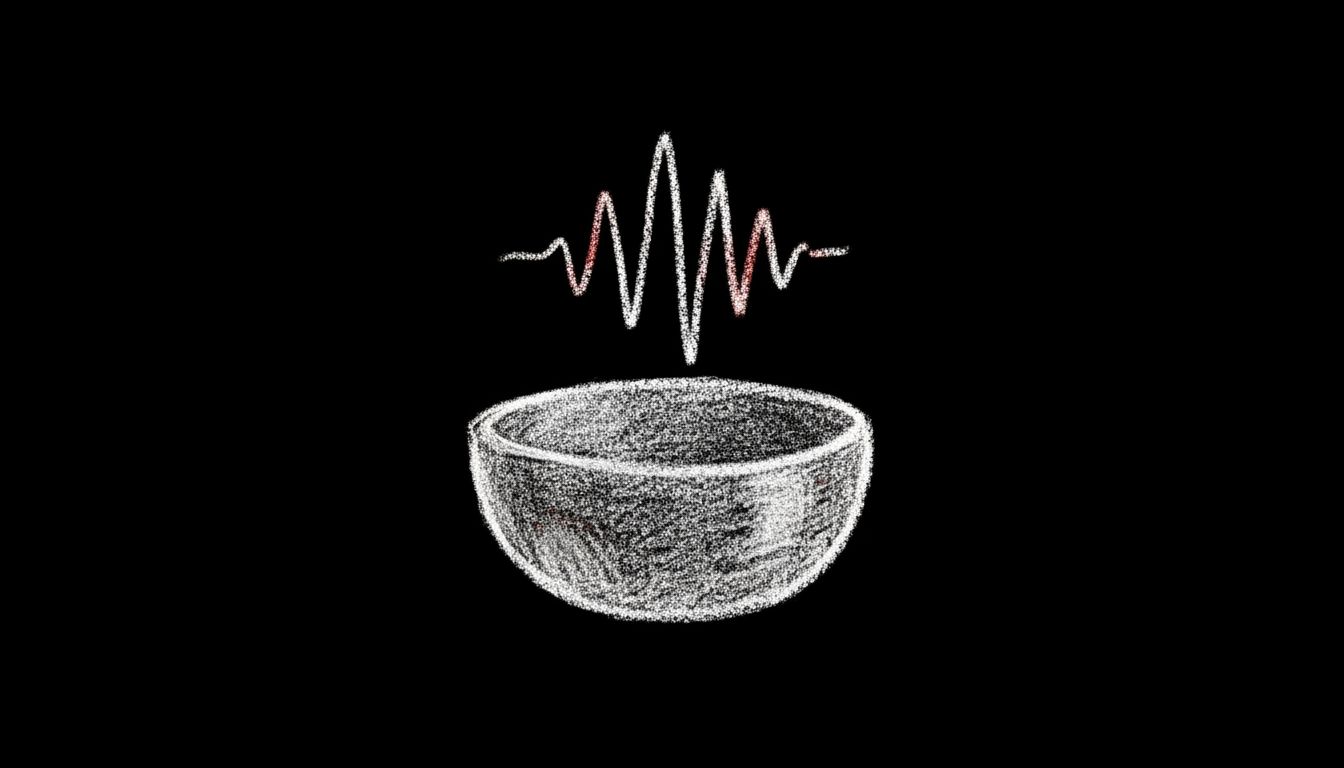
The problem
Every sound healing app on the market uses pre-recorded samples. Press a button, get a WAV file. The problem: a real singing bowl responds to how you touch it. Samples can't do that.
What we did
Built a physics-based audio engine from scratch in Swift. Every sound is synthesized in real-time using formulas from actual acoustics research: Inacio's modal analysis, Bilbao's damping models, Bessel functions for cymatics patterns. No samples anywhere in the app.
Scope
iOS development, audio DSP, physics research, UI/UX, marketing automation
Result
App in beta across 16 languages. Automated outreach running in 14 markets simultaneously. Physics-accurate audio, not recordings.
Most sound healing apps are glorified MP3 players. You tap a bowl icon, a WAV file plays, done. It sounds fine until you realize every tap sounds exactly the same.
Real singing bowls don’t work like that. Strike one gently, you get a warm fundamental tone. Hit it harder, nonlinear harmonics emerge. Run a mallet around the rim, and you get a sustained singing voice where the frequency depends on speed and pressure. The physics are beautiful and complex.
So I decided to synthesize it. From scratch.
The problem: I knew nothing about acoustics. Not the math, not the terminology, not even which books to read. This is where AI research tools changed everything. Deep Research found me Inacio’s 2006 thesis on singing bowl modal analysis. MinerU extracted the LaTeX formulas from a scanned PDF. I indexed Fletcher & Rossing’s “Physics of Musical Instruments” into a local RAG pipeline.
Three weeks later, the app had physics-accurate synthesis for bowls, gongs, crystal bowls, and drums. Each instrument uses its own mathematical model. Bowls use Bessel functions with doublet splitting. Gongs use axisymmetric membrane modes. Crystal bowls model the different wave propagation in quartz versus bronze.
The cymatics visualizer is the same: real Bessel and Chladni patterns, not pre-rendered animations.
This project became the centerpiece of the AI Education masterclass. Not because the app is impressive (it is), but because the story proves a point: one person with the right AI tools can go from zero knowledge to physics-accurate implementation in weeks. That’s the future of work.
Want something like this?
Start a project