education
The Friction Campus: What a Quantum Chemist Turned Filmmaker Taught Me About AI and Education
March 19, 2026
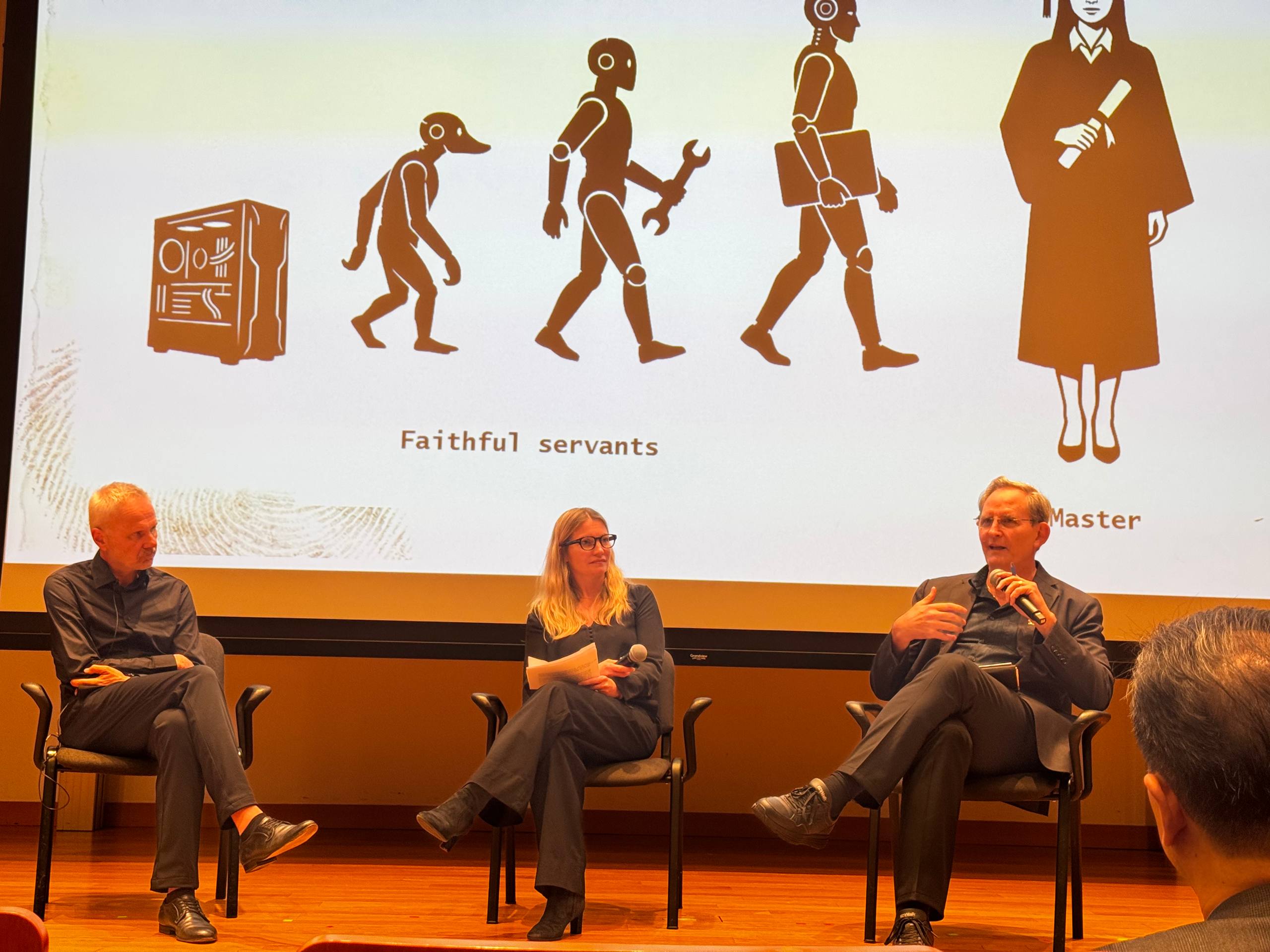
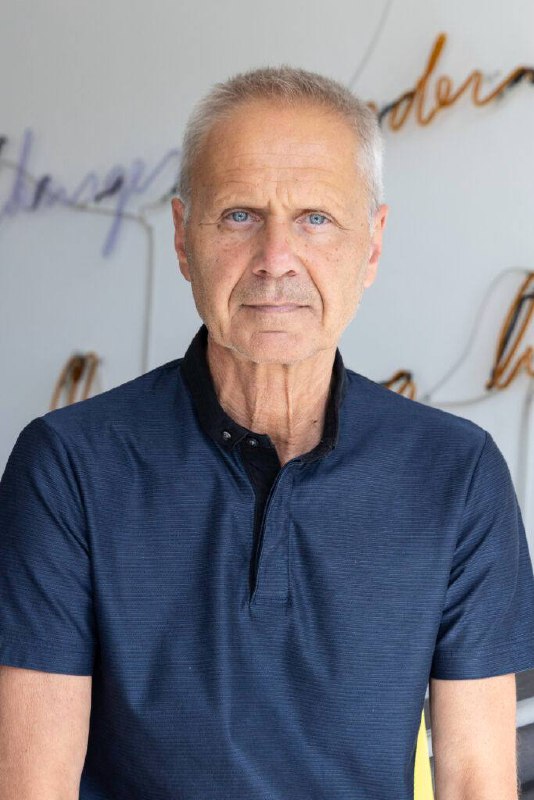
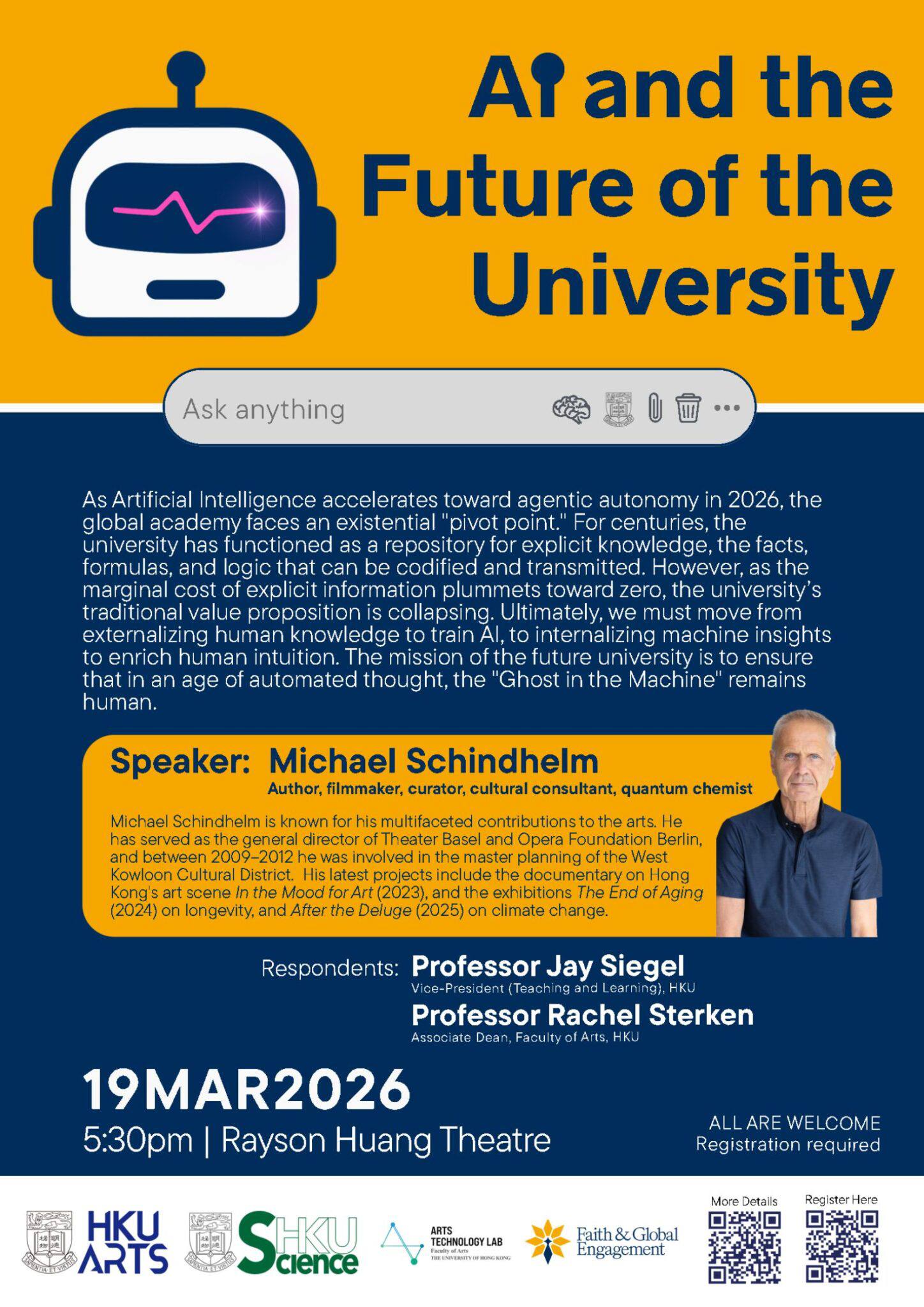
Today at HKU. Rayson Huang Theatre, 5:30pm. A talk called “AI and the Future of the University.” The speaker: Michael Schindhelm. Quantum chemist who became an opera director who became a filmmaker who planned West Kowloon Cultural District for 15 years. Respondents: Professor Jay Siegel (VP Teaching and Learning, HKU) and Professor Rachel Sterken (Associate Dean, Faculty of Arts, HKU).
The kind of biography that makes you question your own.
The core thesis
Universities are broken. Not because they’re behind on AI. Because they’re optimizing for the wrong thing.
Schindhelm draws a line between two types of knowledge. Explicit knowledge: facts, procedures, things you can write down. This is becoming a commodity. AI produces it faster, cheaper, and more reliably than any lecture hall.
Then there’s tacit knowledge. The stuff you can’t articulate. A surgeon’s feel for tissue. A musician’s timing. A teacher’s read on a room. You can’t export this to a PDF. You can only acquire it through experience, apprenticeship, and time.
His argument: universities that keep selling explicit knowledge are selling a product AI already gives away for free. The ones that survive will be the ones that build environments for tacit knowledge transfer.
The friction campus
This is where it gets interesting. Schindhelm proposes something he calls the “friction campus.” Not a department. Not a program. A design principle.
The idea: create deliberate collision zones where students from different disciplines are forced to interact, adapt, and learn each other’s tools. Not to become generalists. To become experts who understand what their work means outside their own silo.
He borrows from aviation and medicine: cognitive forcing protocols. Structured interventions that slow you down. Write the report without AI first. Then generate 100 variations with AI. Then do a gap analysis. The human stays in the driver’s seat.
One example stuck with me. A pianist learning a complex piece plays it agonizingly slowly. Not because slow is better. Because playing fast before you’ve built the right neural pathways means you memorize mistakes. You’re literally hardcoding errors into your body.
The parallel to AI is direct. If you let AI generate before you’ve thought, you memorize the AI’s version. You lose your own.
Four stages of learning AI (like learning an instrument)
Schindhelm maps AI co-evolution to how musicians learn:
- Score focus. Eyes on the page. Absorbing explicit information. Robotic and slow
- Finger focus. Knowledge moves from eyes to hands. Hundreds of hours of zero-mistake practice
- Hearing the music. You hear it before you play it. The score disappears. No explicit information exchange
- Prosthetic incorporation. The instrument becomes a limb. You become an interpreter, choosing from hundreds of possible versions
Applied to AI: learn the system, become fluent, internalize workflows, then become someone who generates hundreds of AI outputs and knows which one is right. The 50+ San Francisco programmers the NYT interviewed confirmed this. They still code. But now they offload grunt work and build more complex programs. And programmers, historically taciturn, now spend their days talking to the system.
The opera rehearsal model
Musicians in an opera first learn their parts alone. Deep solo work. Then they enter collective rehearsals. And everything breaks. Because the way you practiced alone doesn’t fit with how someone else practiced theirs. You have to readjust. Renegotiate. Listen differently.
This iterative process between individual and collective work is Schindhelm’s model for future education. Students work individually with AI (preserving intent, avoiding bias). Then break into interdisciplinary collision zones with peers from different fields.
The friction between what you prepared and what the room demands. That’s where learning happens.
Why this resonates
I’m working on a mockumentary series called “Redundant”. It’s set in Hong Kong. A planted actor, posing as a displaced financier, enters the city’s craft world to find the profession AI can’t replace. Real artisans share real fears. He asks them about P&L.
Comedy on the surface. But underneath it’s about the same thing Schindhelm described: what happens when two worlds collide.
The banker’s world: compliance, Bloomberg terminals, basis points. The street world: spray cans, improvisation, tacit knowledge you can only learn by doing. The lion dance sequences in the film are pure friction. The dancer inside the lion head can’t see. They feel their partner through the fabric. No instruction manual for that.
Schindhelm’s “friction campus” is basically the thesis of the film, articulated as educational policy. Collision zones. Desirable friction. The productive discomfort of doing something you’re terrible at.
Everything I think about this topic is in the treatment. A human being is a cosmos, not a dot. And it’s good that universities and people like Schindhelm are having this conversation.
Schindhelm’s personal story
He studied quantum chemistry in the Soviet Union. Not because he loved chemistry. Because natural sciences were the only discipline where free thinking was allowed. Everything else was censored, brainwashed. So he went where the freedom was, even if it wasn’t his passion.
This hit close to home. My grandparents were born and lived in Voronezh. Same country, same system, same walls around thought. The idea that you pick a discipline not for love but for intellectual freedom, that resonates on a personal level.
Then the wall came down. Everything changed. He became an opera director. Then a filmmaker. Then a cultural planner. He spent 15 years building the master plan for West Kowloon Cultural District in Hong Kong. A few years before, he had no idea he’d ever come here.
“If you had asked me at age 30 what I would do in 10 years, I had no idea.”
That’s not a failure of planning. That’s what a life looks like when you have enough cross-disciplinary legs to survive disruptions. Which is exactly his point about education.
The Q&A
The real gold came after the talk.
Jay Siegel (VP Teaching and Learning, HKU) dropped the line of the evening: “The cognitive system is not just the human working with AI. The cognitive system is this room.” When we see each other as expert nodes in a shared cognitive network, the system works better than any individual. But as long as we measure each other by impact factors and publication counts, the system never exceeds the sum of its parts.
Rachel Sterken (Associate Dean, Faculty of Arts, HKU) pushed back on the generalist risk: if everyone becomes interdisciplinary, who socializes students into deep traditions of knowledge? Schindhelm’s answer: the friction campus has both vertical and horizontal dimensions. You still need deep experts. But “the expert of the future is not a Fachidiot,” as they say in German. Someone totally focused on one thing with no clue about anything else.
Brian Tang from Light Lab (law, innovation, technology, entrepreneurship) asked about scaling. He limits classes to 30 for apprenticeship quality. How do you scale friction? Schindhelm’s answer: make it horizontal, available to everyone from day one. Not another silo you sign up for.
Chris Swester, former Dean of Architecture at HKU, asked the hard question: historically, polymaths are outliers. Often they emerge in opposition to the system. Can we mass-produce what used to be exceptional? Schindhelm pointed to architecture itself: a discipline that became radically interdisciplinary over 50 years without losing its core.
Stefan Auer from European Studies, who studied electrical engineering in Communist Czechoslovakia, bans all electronic devices in his classroom. Are we doing students a disservice by giving them AI shortcuts? Schindhelm’s response: having lived half your life in an analog world used to be a handicap. Now it’s a privilege. “We are the last. It will never happen again.”
A chemistry student asked about the power of repetition. Schindhelm referenced Elizabeth and Robert Bjork at UCLA, who run a Lab of Learning and Forgetting. Their research: forgetting is essential to learning. Early and late learning phases require completely different approaches. Learning many things over a long period is the only way to build long-term memory.
The takeaway
Knowledge is becoming free. Skills are becoming transferable. The scarce resource is the ability to sit in a room with people who think differently and produce something none of you could have made alone.
The idea that you get a diploma and you’re done learning is dead. Continuous education isn’t a nice-to-have. It’s the only way to survive a world where the next disruption is always around the corner. The fact that a professor can invite you to a talk like this, that you can walk into a room at HKU and hear a quantum chemist talk about opera and AI, that in itself is the friction campus in action.
Schindhelm calls it friction. I call it the thing every good creative project has in common.
Interested in this?
Learn about AI Education →